

ARTICLE | BGBx
Procurement’s Expanding Role in Pharma Marketing
What parallel surveys of procurement and the brand teams they serve reveal about the gap between them
By Drew Bustos, Chief Growth Officer, BGB Group
Procurement and brand teams work for the same company, fund the same launches, and answer to the same P&L. Ask them what worries them, what they are chasing this year, and how they are using AI, and you would expect broadly similar answers.
They are not similar. BGBx surveyed procurement leaders across pharma and biotech, then put the same questions to the brand teams procurement serves, in eight therapeutic areas, one hundred respondents per survey. Read side by side, the answers describe two functions running different races on the same track. For procurement leaders, that gap is the finding. It explains why budget conversations stall, and it points to where procurement’s next source of leverage sits.
What Keeps Each Side Up at Night
Procurement’s worry list is cost, three ways. Controlling costs and hitting savings targets ranked first at 51 percent, with inflation and supply chain volatility close behind. Even when procurement looks at its agency relationships, the top concern is staying within budget. The lens is consistent, and it is the lens the function is paid to hold.
Now the other side of the table. In none of the eight therapeutic areas did brand teams put cost at the top. Their leading worries are brand strategy and positioning, hitting launch windows, standing out in crowded categories, and keeping up with digital disruption. Cost pressure shows up on their lists, but never first. Brand teams are not ignoring money. They are measured on growth, and their worries follow their metrics. One worry, though, keeps surfacing just below the headline items: measuring campaign ROI cracks the top three in three of the eight areas. Hold that thought.

Figure 1. Top three worries, nine audiences, grouped by #1 response. Each box represents 10 points. Parallel BGBx surveys, N=100 each.
Same 18 Months, Different Finish Lines
Worries could be dismissed as temperament. Goals cannot. We asked both sides to name their most critical goals for the next 12 to 18 months, and the split repeats almost exactly.
Procurement’s list: achieve cost savings at 65 percent, then strengthen risk management and improve process efficiency. Brand teams are running a different race. Positioning and competitive differentiation led the list outright in five of the eight areas and tied for the top spot in a sixth. The remaining two led with marketing ROI and market access. Cost reduction topped the list in zero of eight. Notice that brand teams are not a monolith. Across the eight audiences there are four different finish lines: positioning, new indication launches, marketing ROI, and market access. They disagree with each other plenty. They just never disagree in procurement’s direction.
Here is why that matters. These two sets of goals get negotiated against each other every planning cycle, usually without either side seeing the other’s list. A savings target meets a launch calendar, neither was set with the other in mind, and the collision lands mid-launch, when it is most expensive. The blind spot, not any single line item, is where budgets stall and working relationships fray.

Figure 2. Top three goals for the next 12 to 18 months, nine audiences, grouped by #1 response. Each box represents 10 points. Parallel BGBx surveys, N=100 each. In CNS, new indication launch and positioning tied at 39 percent; launch is shown first.
The Gap Is Widest Where the Stakes Are Newest
Nowhere is the distance between the two functions more measurable than AI. Procurement is moving deliberately: one in ten teams uses AI tools today, while nearly all the rest are assessing options or planning to, with practical applications in mind such as vendor risk assessment, contract analysis, and spend analytics.
Brand teams are not waiting. Across the eight therapeutic areas, between 40 and 62 percent reported actively using AI in their marketing and communications work. That is four to six times procurement’s adoption rate.
For a function accountable for vendor risk and governance, that gap is not trivia. Every AI tool a brand team adopts is a new vendor relationship, a new data exposure, and a new compliance question. Procurement can get in front of that adoption or clean up behind it. There is no third option.
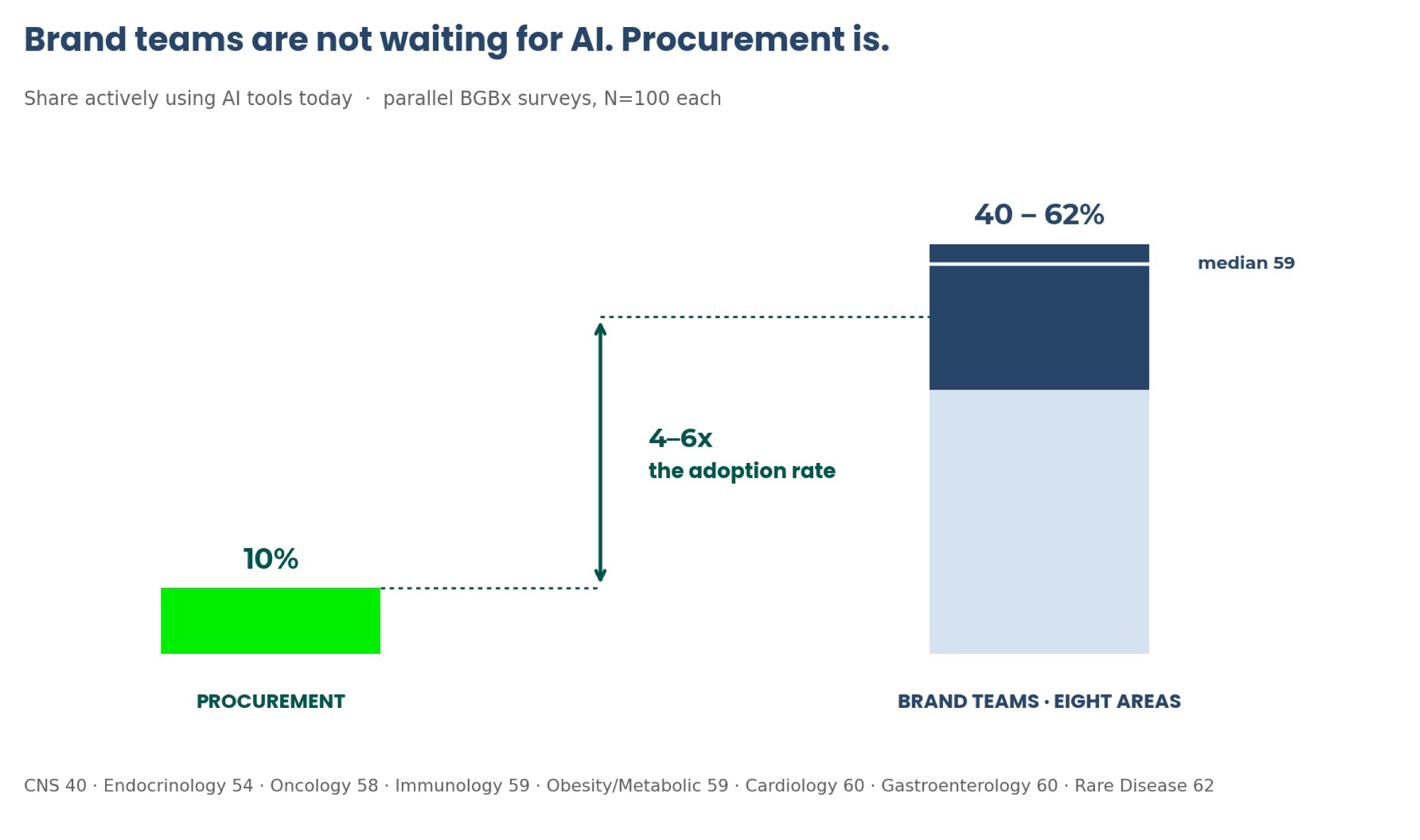
Figure 3. Share of teams actively using AI tools today: procurement vs brand teams across eight therapeutic areas (range 40 to 62 percent, median 59). Adoption scale wording varied slightly between survey waves; active use includes partial and broad integration where surveys distinguished.
So What Now?
None of this calls for a reorganization. It calls for procurement to act on what the two datasets say at once. Three moves matter most.
01 Put your savings plan and their launch calendar in the same room. Align procurement’s cost targets with brand’s launch and differentiation goals before the fiscal year locks, not after a scope dispute. A saving that slows a launch is not a saving anyone remembers fondly.
02 Get ahead of AI adoption instead of behind it. Your brand teams are already using AI at several times your rate. Stand up lightweight vendor and data governance for AI tools now, while adoption is still shapeable, and procurement becomes the enabler rather than the bottleneck.
03 Start the shared scorecard where you already agree: ROI. Proving the money worked is the one worry both sides share. Clear ROI metrics rank as the second-strongest way partners build trust with procurement, at 50 percent, and measuring campaign ROI cracks brand teams’ top three worries in three of the eight areas. Build the joint vendor scorecard on ROI first, then add timeline reliability and launch readiness. The annual review becomes a shared exercise instead of a standoff.
Procurement already holds the hardest job in commercial operations: keeping cost, risk, and timelines moving at once. The data suggests its next act is bigger. The function that sees both scorecards is the only one positioned to reconcile them.
The Same Questions, Eight Brand-Team Audiences
For readers who want the detail behind the comparison, here is what each brand-team audience told us, next to procurement’s answers to the same questions.
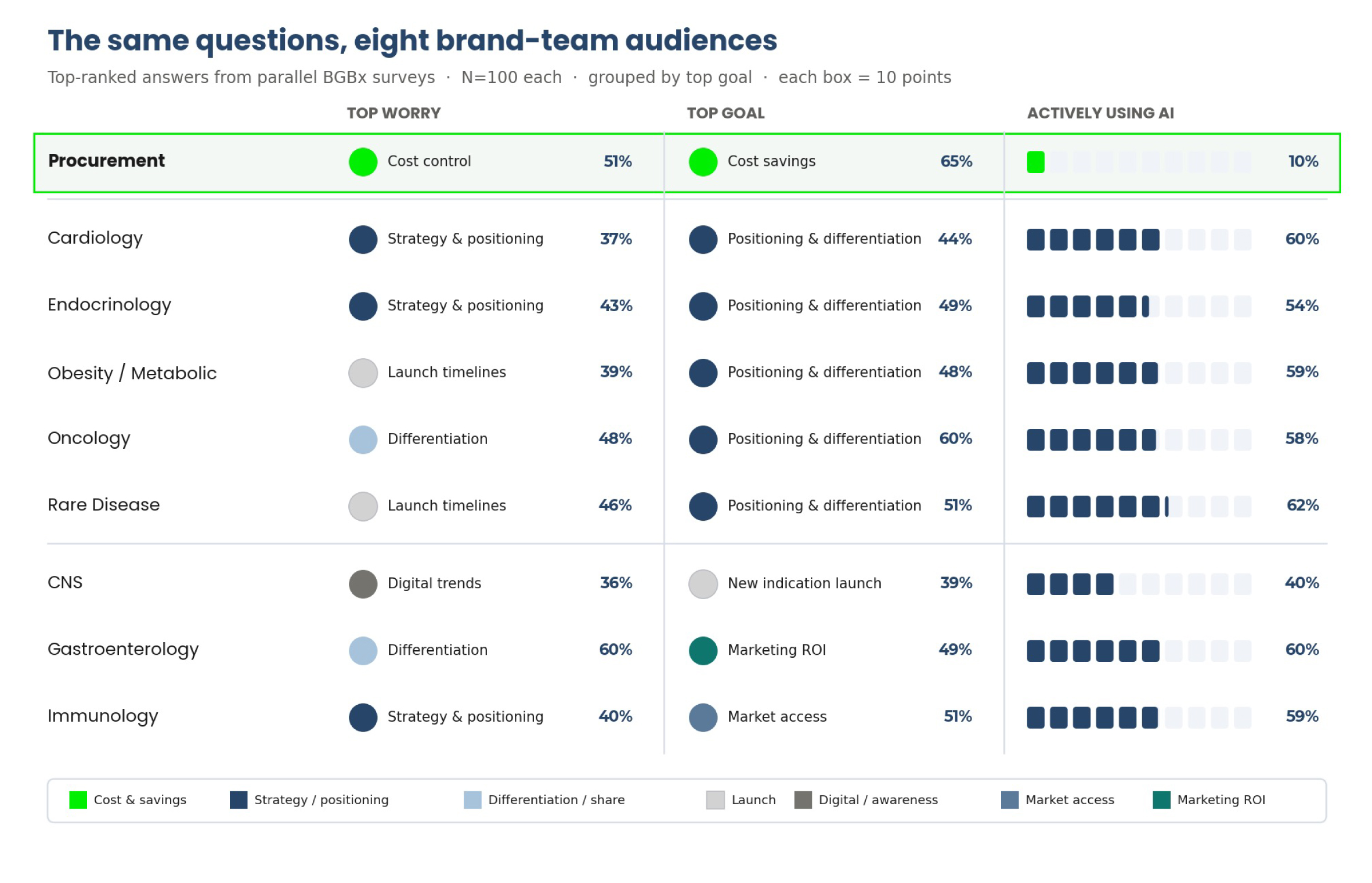
Figure 4. The same questions, eight brand-team audiences. Survey questions as fielded. Top worry: “In your role overall, what are the top three issues keeping you up at night?” (procurement version reads “In your role in Procurement overall…”). Top goal: “What are the top three goals that are the most critical for your [therapeutic area] brand team to achieve in the next 12-18 months?”; the procurement version asks about “your procurement team… particularly related to agency vendor management.” AI use reflects extent of AI tool adoption for marketing or communication tasks (brand teams) and for sourcing, vendor management, or related tasks (procurement). Chip labels condense the top-ranked response option; percentages are the share ranking that option in their top three (AI: share actively using, including partial and broad integration where surveys distinguished). Parallel BGBx surveys, N=100 each, fielded 2025 to 2026, most recent wave shown where two exist. Question and scale wording evolved slightly between waves. In CNS, new indication launch and positioning tied at 39 percent for the top goal.

About the Author
Drew drives innovation in life sciences through strategic vision and data-driven leadership. His extensive research across therapeutic areas and analytical approach have delivered substantial growth and market expansion, positioning him at the forefront of industry solutions.
Drew Bustos
Chief Growth Officer
BGB Group
To discuss these findings and what they could mean for your organization, contact Sean Mahoney, SVP Business Development, BGBx, at smahoney@bgbgroup.com
About BGBx
BGBx is an independent commercial solutions partner for pharmaceutical and life science companies and their brands, combining consulting, communications, science, creativity, data, technology, innovation, and digital capabilities to deliver breakthrough results. Through BGBx Consulting and BGBx Communications, the company helps clients set strategy early, stay aligned throughout the product lifecycle, and execute through marketing and communications programs that drive impact. BGBx is Built for Breakthrough. bgbx.com
Selected Resources From BGBx
Top Challenges and Goals in Oncology Branding (Article)
BGBx Obesity Brand Insights: Is Your Strategy Keeping Pace? (Infographic)
Is Oncology Ready? Four Forces Defining the Next Five Years (White Paper)
The GLP-1 Aftershock Effects (Webinar)
2026 Access Pulse Check: Evolving Controls in Oncology (White Paper)
Designed for Action: Behavioral Science, AI and the Future of Healthcare Experiences (Webinar)
5 Ways AI is Actually Impacting Pharma Launches (Blog)
Why AI Isn’t Solving Go-to-Market Failure in Pharma (Blog)
Policy Fatigue and the Future of Patient Access in Pharma (Podcast)
Access is no longer just a market access problem (Article)
What Your Omnichannel Strategy Can Learn From a Forest (Article)
5 Common Mistakes to Avoid with Omnichannel Marketing (Article)
The Optimal Omnichannel Mix for Successful Launches (Article)
Key Elements for Commercializing Successful Startups (Article)
Gut Check: Competitive World of Gastroenterology Brand Promotion (Article)
